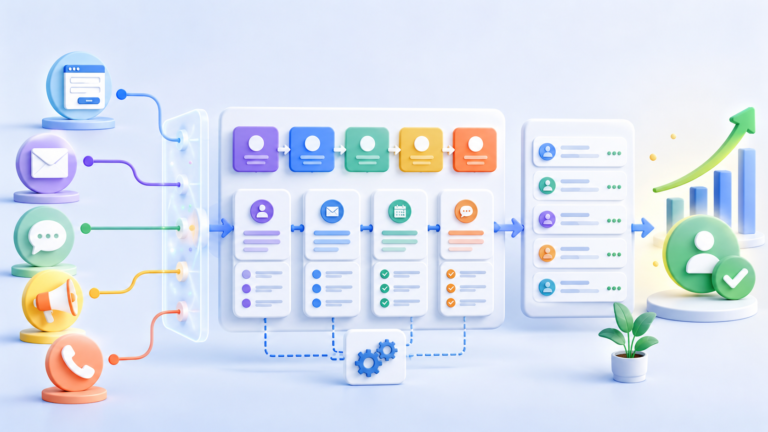
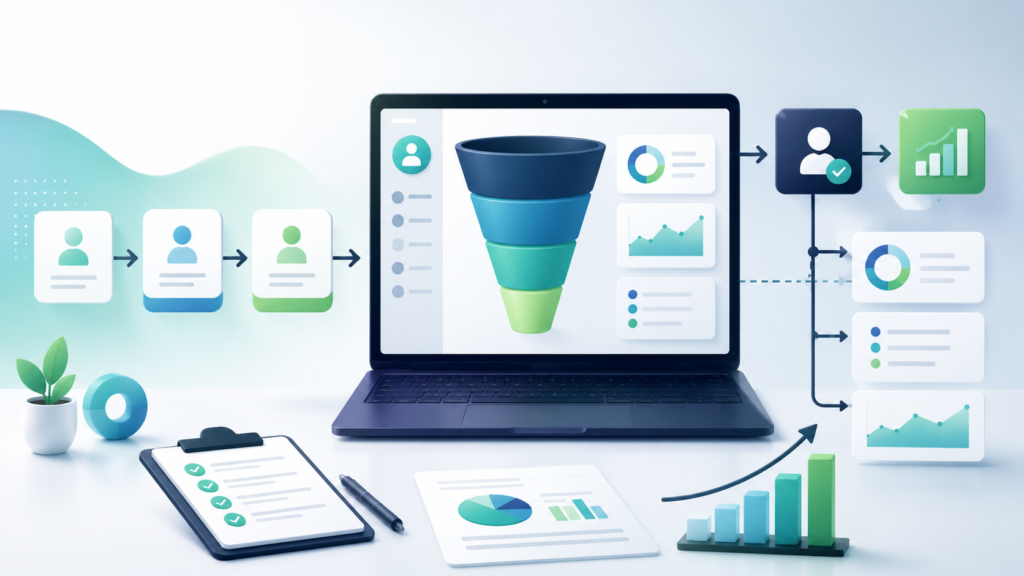
A sales funnel is not just a nice diagram for a presentation. A proper funnel helps you understand how a person moves from the first touchpoint to a deal, where they drop off, and which team actions actually move the sale forward.
Without a funnel, sales often look like a set of disconnected actions: someone sends a message in chat, someone leaves a request, a manager calls back, then forgets to follow up, and later the client disappears. As a result, it becomes hard to understand where the problem is: traffic, request processing, qualification, the offer, or the manager’s work.
A good funnel makes the process transparent. The team sees the stages, the manager understands the bottlenecks, and marketing and sales stop arguing based only on feelings.
What is a sales funnel
A sales funnel is the customer’s path from first interest to purchase. Usually, it shows how a person moves through several stages: they discover the company, leave a request, speak with a manager, receive an offer, and make a decision.
For example, a simple funnel can look like this:
- website visitor
- lead
- qualified lead
- consultation or demo
- commercial offer
- negotiation
- deal
The stages will differ for different businesses. In ecommerce, the path may be shorter. In B2B sales, it is often longer and includes several touchpoints, approvals, and follow-up conversations.
The main point is that the funnel should reflect the real process, not an abstract scheme from a textbook.
Why a business needs a funnel
A funnel helps manage sales without guessing. When the stages are described, it becomes clear where clients are being lost.
For example:
- many people visit the website, but few leave requests
- requests come in, but managers reply too slowly
- consultations go well, but offers rarely turn into deals
- deals get stuck at the approval stage
- follow-ups are almost never done
- Without a funnel, all of this looks like “sales are bad”. With a funnel, you can see the exact point that needs improvement
Step 1. Describe the current customer path
Start not with CRM and not with automation, but with a simple description of how the customer currently moves toward a purchase.
For example:
- They see an ad or article
- They visit the website
- They submit a request
- They receive a reply from a manager
- They answer qualifying questions
- They receive an offer
- They compare options
- They make a decision
- They buy or refuse
It is important to describe the real process, not the ideal one. If requests come through Telegram, some leads stay in email, and managers keep notes in a spreadsheet, this should also be recorded.
This is usually the stage where it becomes clear where the process is already breaking.
Step 2. Split the process into stages
After describing the customer path, turn it into clear funnel stages.
For small and mid-sized businesses, a simple structure is often enough:
- new lead
- contact established
- qualification
- offer sent
- negotiation
- won
- lost
Do not create too many stages. If the funnel is overloaded, managers stop maintaining it properly. It is better to start with 5-7 clear stages and refine the structure later.
Each stage should have a clear meaning. For example, “offer sent” means the client actually received a specific commercial offer, not that “we might send something someday”.
Step 3. Define the transition criteria
One common mistake is creating stages without clear rules. As a result, one manager moves a deal to the next status after a call, another after an email, and a third when it simply “feels like the client is interested”.
For the funnel to work, each stage needs a transition criterion.
For example:
- “new lead” - the request has just arrived
- “contact established” - the manager has contacted the person
- “qualification” - it is clear who the client is, what they need, and whether there is deal potential
- “offer sent” - the client has received a specific offer
- “negotiation” - terms, price, timing, or details are being discussed
- “won” - the client has paid or confirmed the deal
- “lost” - the client refused or stopped responding after several attempts
- These rules help the team maintain the CRM consistently
Step 4. Collect basic metrics
A funnel without metrics quickly turns into a simple list of deals. To manage sales, you need to look at numbers.
A basic set of metrics includes:
- number of leads
- conversion between stages
- average cost per lead
- average deal cycle length
- average deal size
- percentage of won and lost deals
- loss reasons
- first response time
- number of follow-ups per deal
You do not need complex analytics from day one. At the start, it is enough to understand how many leads come in, how many reach the offer stage, and how many become customers.
Step 5. Find bottlenecks
Once stages and metrics are visible, you can look for weak points.
For example:
- if there are too few requests, the problem may be traffic, the offer, or the landing page
- if leads do not pass qualification, the ads may be attracting the wrong audience
- if offers do not close, check pricing, packaging, argumentation, or the manager’s work
- if deals get stuck, there may not be enough follow-up
- if many people refuse after the first call, review the script or qualification process
- This is exactly why a funnel is useful: not just to look at sales, but to understand where revenue is being lost
Step 6. Set up the CRM
When the funnel logic is clear, you can move it into a CRM. Not the other way around.
The CRM should reflect the real sales process. If the stages inside the system do not match how the team actually works, managers will quickly start updating it just for show.
In the CRM, it is worth setting up:
- funnel stages
- required fields
- lead sources
- loss reasons
- tasks and reminders
- responsible managers
- basic reports
- email or message templates
- For a start, you can use Pipedrive, HubSpot CRM, Zoho CRM, Freshsales, monday CRM, or another tool the team will actually use every day
Step 7. Automate routine tasks
Automation is not needed immediately and not everywhere. First, you need to understand the process, then remove manual actions.
You can automate:
- creating a deal after a website request
- notifying a manager about a new lead
- follow-up reminders
- an email after the first contact
- status changes after a client action
- a task after an offer is sent
- notifications to the manager about stuck deals
- basic report collection
- The main goal of automation is not to make the system more complicated, but to prevent the team from forgetting important actions
Step 8. Set up follow-up
In many businesses, sales are lost not because the client is uninterested, but because the manager does not return to them on time.
Follow-up should be part of the funnel, not something that depends on a manager’s memory.
You can define simple rules:
- if the client does not reply after the first email, follow up in 1-2 days
- if the offer has been sent, return to the client in 2-3 days
- if the client is thinking, create a task for the next contact
- if the deal is lost but not permanently, add the client to a future follow-up sequence
- This helps the team lose fewer warm leads
Step 9. Analyze loss reasons
Loss reasons should be recorded. Without this, it is hard to understand what exactly is blocking sales.
Examples of loss reasons:
- too expensive
- no budget
- chose a competitor
- not relevant
- no response
- product is not a fit
- long decision-making process
- missing required feature
- not a target client
If most losses are connected with price, review the offer packaging and value. If many leads are not a fit, the problem may be ads or content. If clients often choose a competitor, study the comparison and your sales arguments.
Step 10. Update the funnel regularly
A sales funnel is not something you build once and leave forever. It needs to be reviewed.
For example, once a month you can check:
- which stages work properly
- where deals most often get stuck
- which sources bring the best leads
- which managers close deals faster
- which loss reasons repeat
- where automation is needed
- which stages are unnecessary
- If the process has changed, the funnel should be updated too. Otherwise, the CRM will show an old scheme instead of the real picture
Common mistakes when building a funnel
The most common mistake is making the funnel too complex. The team gets 15 stages, dozens of fields, and unclear rules. As a result, managers stop maintaining the CRM properly.
Other common mistakes:
- stages do not match the real process
- there are no transition criteria
- loss reasons are not recorded
- there are no follow-up tasks
- CRM is filled in after the fact
- marketing and sales look at different data
- there is no process owner
- nobody analyzes the funnel regularly
- A working funnel should be simple, clear, and useful for the team
What tools to use
Different tools can be used to build a funnel. It depends on the size of the business and the complexity of the process.
For a simple start:
- Google Sheets
- Airtable
- Trello
- Notion
For a full CRM:
- Pipedrive
- HubSpot CRM
- Zoho CRM
- Freshsales
- monday CRM
For automation:
- Zapier
- Make
- n8n
- built-in CRM automations
At the start, the most important thing is not choosing the most powerful tool, but describing the process and making sure the team actually follows it.
How to know the funnel works
The funnel works if the team can see the process and manage it.
Good signs:
- all new leads go into one place
- every deal has an owner
- it is clear which stage the client is in
- managers do not forget follow-ups
- the manager sees bottlenecks
- loss reasons are recorded
- lead sources can be compared
- reports are created without manual chaos
If the funnel exists only in the CRM, but the team continues working in chats and spreadsheets, the process needs to be simplified or explained again.
Final thoughts
A sales funnel helps a business see the customer path from first touchpoint to deal. It shows where leads are lost, which stages are weak, and what needs to be improved to make sales manageable.
Start not with buying a CRM, but with describing the real process. Then split it into stages, define transition criteria, collect basic metrics, set up follow-up, and only after that automate routine tasks.
A good funnel is always transparent: the team understands what to do next, and the manager sees exactly where revenue is being lost.